Shock waves have different characteristics in comparison
to ultrasound. Ultrasound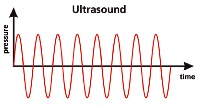 usually consists of periodic oscillations with limited bandwidth. Shock waves are single, mainly positive pressure pulses that are followed by comparatively small tensile wave components.
 Ultrasound applies an alternating high frequency load to the tissue, with a frequency range of several megahertz, thus leading to heating, tissue tears and cavitation at high amplitudes. The shock wave’s effect in comparison, is forward directed energy (in the direction of the shock wave propagation). Its force takes effect at the interface and further that can be increased to enable the destruction of kidney stones, for instance. Since these dynamic effects basically occur at interfaces with a jump in the acoustic resistance but hardly ever in homogenous media (tissue, water), shock waves are the ideal means for creating effects in deep tissue without affecting the tissue in front of it.