OUR CLIENTS SAY IT BEST!
[embedplusvideo height=”388″ width=”640″ standard=”http://www.youtube.com/v/yLLUeQ8igIk?fs=1″ vars=”ytid=yLLUeQ8igIk&width=640&height=388&start=&stop=&rs=w&hd=0&autoplay=1&react=1&chapters=¬es=” id=”ep8883″ /]
Dr. James Stewart, VMD & President“We have used ESWT since April 2002. Our results have been very good, prompting the clinical impression that it is the treatment of choice for tendon, ligament and some stress fractures.
Our client response has been enthusiastic and repetitive.”
Yergey, Stewart & Vallance & Associates Charted, Laurel, MD
“We have been using ESWT since March 2002 with excellent repeatable results. We are very pleased with the fact that there is only one applicator probe and no additional consumables required. We’ve had good cooperation from the company when technical questions have arisen.”
Dr. Paul McClellan, DVM, San Dieguito Equine Group, San Marco, CA
“We have been using extracorporeal shock wave therapy for the last 3 years to treat conditions such as suspensory desmitis, avulsion fractures, bucked shins, stress fractures, maladaptive bone disease, inflammation of the dorsal spinous process (“kissing spines”) and osteoarthritis.Early clinical results are promising. Currently, we have been very pleased with the good degree of clinical success (as determined by improved lameness, way of going and performance record) and client satisfaction we have had in the treatment of multiple cases of documented overriding dorsal spinous processes and kissing spines, as well as maladaptive bone disease.”
Dr.Kate Chope, VMD , Clinical Assistant Professor in Large Animal Ultrasound & Dr. Jose M. Garcia-Lopez, VMD, Diplomate ACVS, Associate Professor in Large Animal Surgery
Tufts University – Veterinary Medical Teaching Hospital, North Grafton, MA
“I became interested in shockwave therapy for its neovascularization effects. I’ve been using this therapy with racehorses and pleasure horses for about five years now, and am very pleased with the results. [EXPAND read more] In racetrack medicine, the emphasis is often on alleviating pain so the horse can run again; which isn’t always in the horses’ best interest. What I most appreciate about shockwave technology are both the analgesic and the therapeutic benefits. It is a better and more ethical alternative then injecting the animal with cortisone to bypass pain so it can continue to race or perform. This technology not only helps the horse feel better but aides in the healing process. Many modalities do one or the other, but shockwave therapy accomplishes both at the same time. Often, when there is pain in one area, the horse will compensate or overcompensate in another area, creating additional problems and a vicious cycle. If you can stop the pain cycle and address the problem at the level of causation, it makes a big difference. The horse not only feels better, you’re actually making him better — and supporting the horse’s wellbeing and longevity. I’ve seen quite a few very nice turnarounds with shockwave therapy in cases where there was initial concern about the horse’s career being in jeopardy. I have used the Storz MP 50 Vet shockwave therapy machine with many cases over the years and have had great success treating a variety of problems and conditions including tendonitis, suspensory ligament desmitis, joints, backs, fractures, endostietis, etc. Recently I have used the technology to treat severe lacerations, wounds and bone abnormalities. I have found the decrease in healing time to be very impressive. A recent case I initially estimated 4-6 months for healing, but the horse was out of the clinic and on their way home in 45 days. I was amazed and pleased with the results. In fact, I have documented — and am in the process of writing up — this particular case of hind leg trauma and the dramatically shortened healing time using shockwave therapy. Shockwave is a great adjunct therapy when used in conjunction with many other treatment modalities. For instance, I’ll commonly use shockwave on the feet of horses running on hard surfaces in conjunction with corrective shoeing. Of course shockwave can’t be used in isolation. It’s important to make a big picture assessment, which may involve corrective shoeing, equipment changes or training modification, thus allowing the horse sufficient time to heal. Shockwave therapy is absolutely a great piece of therapy to add to the mix to keep the horse at the top of its game and as pain free as possible for as long as possible.[/EXPAND] The bottom line is that I find shockwave an integral part of my treatment armament and practice. The MP 50 Vet shockwave machine is an outstanding tool for helping horses stay sound, happy and healthy.”
Dr. Judy Tubman, VMD
Kent Veterinary Center – Centreville Equine – Millington, MD
“I have been using shockwave therapy for more than 10 years. We first started to incorporate it into our equine practice back in 1999 at the old facility known as Rochester Equine Clinic. [EXPAND read more] I worked there as an equine physiotherapist and rehab specialist and we began incorporating it into that aspect of the practice. In 2005 Mike Davis, who was a partner and surgeon at Rochester founded and opened New England Equine Medical & Surgical Center, a 35,000 square foot state of the art referral hospital in nearby Dover NH. Again, as part of the equine physiotherapy and rehab program Dr. Davis and I continued to incorporate shock wave into the practice there. I am happy to say that we have never had any type of negative impact on a case from applying shock wave therapy.
Certainly some cases respond more favorably and more immediately than others, but providing that your case selection is based on good solid diagnostic work, shock wave therapy is a highly effective treatment for a variety of lameness conditions in the horse. Extra corporeal shock wave therapy is a non invasive therapy that I feel 100% comfortable using because, in our experience, it has proven itself to be safe, effective, and when used appropriately has no risk or “downside” unlike some of the more invasive treatment techniques.
At New England Equine, we had been using a lower energy, radial shockwave device with good results since 2005, but we recently purchased the Storz Duolith® Vet system because we wanted a higher energy, focused device to be able to treat additional deeper seated lesions. With the addition of MRI and CT technologies to the practice occurring over the last few years, we’re now able to identify problems that we couldn’t image previously; and with the high focus shockwave device we can treat at those deeper levels. For example, with distal DDFT (deep digital flexor tendon) lesions which are difficult to access because they’re so far down within the foot, we can now get the depth of penetration needed to effectively treat those lesions. Depending on the exact location of the lesion, we treat through the bulbs of the heels or through the frog, or in some cases both. We can also treat other structures within the hoof such as the impar ligament and even the navicular bone. With the increased depth of penetration, we are now also able to treat sacroiliac desmitis as well. Those ligaments are located deep under thick layers of muscle tissue and with the lower energy system we never felt like we could get to those structures effectively so we didn’t treat them with shock wave, we usually injected them. We continue to treat proximal hind and fore limb suspensories on a very regular basis as we have for many years.
We tried all the leading high-energy devices on the market and settled on the Duolith, for a few reasons. One of which is that it provides both focused and radial shockwave options and we do feel there are cases where we would still opt for radial shock wave over focused. With the Duolith we have that choice. The other devices out there are also highly effective and good quality but the Duolith is significantly quieter than other high-energy focused devices and more comfortable for the patient (we have applied it to ourselves to test this). These are important features to us. The probes are also smaller and are easier to fit between the bars of a horses shoe when treating through the frog. We can get a better contact with the frog surface during treatment which is essential for the transmission of those waves into the hoof. There are standoffs to attach to the probe to adjust depth of penetration as opposed to having to change out probes and are easy to use. The depth of penetration and maximum energy levels are greater than any lesion should require and are fully adjustable so you can tailor the treatment specifically for each individual case.[/EXPAND]
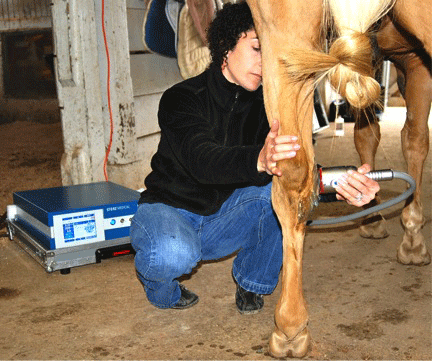
We use extracorporeal shockwave to treat a wide variety of musculoskeletaland lameness disorders in our practice and have been very pleased with the results. Case selection is critical as is a carefully implemented rehabilitative exercise program. There is an extensive group of Storz shock wave users across the country who are very willing to share their experiences and exchange treatment protocol information which is also very helpful. We are pleased to be a part of that group. We treat primarily sport horses; hunters, jumpers, dressage, and endurance horses.
We find shockwave therapy be a very safe and effective therapeutic option and a very useful tool in treating lameness in the horse.”
Patricia Quirion-Henrion, MA, NAVP – Equine Rehab Therapist
New England Equine Medical & Surgical Center, PLLC
www.newenglandequine.com
READ ALSO PATRICIA’S CASE STUDY!
“I’ve been using shock wave therapy in my practice for over ten years and feel like it is a very effective treatment for certain musculoskeletal disorders in the horse. We were one of the first equine practices to incorporate extracorporeal shock wave therapy in the US [EXPAND read more] at the old facility Rochester Equine Clinic from 1999 to 2005 and since 2005 at our new state of the art hospital New England Equine Medical and Surgical Center located in Dover NH. I specialize in lameness in sport horses and equine orthopedic surgery so I see a lot of sports injuries which end up being good candidates for shock wave therapy. We of course use other regenerative therapies including stem cell and platelet rich plasma injections but there are certain cases in which shock wave is the best choice in treatment, particularly when an attachment of soft tissue to bone is involved. We also have begun combining shock wave therapy with these other regenerative therapies and have so far been pleased with these results. Good case selection and diagnostics are essential when treating with shock wave therapy. In our experience certain cases will benefit more from shock wave therapy than others and for some cases shock wave just is not an appropriate therapy. In my opinion you have to be confident that you can get the energy effectively transmitted to the site of the lesion (injury) otherwise you are not going to have good results.
Prior to this year we had been using a lower energy radial device and had consistently good results, however, since we have added an advanced imaging center to our practice which includes MRI and CT we have begun to identify many more injuries that we previously could not diagnose nor could we access them with the lower energy shock wave device. We felt that we needed to add a high energy focused device to our practice to be able to treat these lesions, many of which are located deep within the horse’s foot.
After trying all of the devices on the market we settled on the Storz Duolith, which gives the option of using radial shock waves as well as very high energy focused shock waves. There were several reasons for selecting the Duolith but one major factor was the operating cost. All of these high-energy devices are more expensive to operate than the radial devices but the Storz operating cost is a fraction of what the others are. The Duolith probe lasts for 1 million impulses where as the others typically last for only 50,000 impulses before you have to turn the probe in and purchase a new one. As we are always trying to keep the cost of treatment down for our clients without compromising the quality of the treatment it made sense to choose a device which allowed us to administer the necessary number of impulses without worrying about the high cost associated with each single impulse.
If you start treating with less impulses to keep your costs down rather than treating with the appropriate number of impulses then you are not providing the best service to your client or patient. At New England Equine, we charge a flat rate to our clients for the first 2000 impulses which is the average dose per treatment site. For larger more extensive lesions you obviously need to treat with more impulses to get the necessary energy delivered to the entire injury site. For larger treatment areas requiring more impulses we charge a small additional fee base on the additional impulses to cover the increased cost that we sustain. It still keeps the treatment cost to the client quite reasonable. If our per impulse cost was say 5 to 8 times what it is with the Duolith (as it would be with some of the other devices) we would have to choose between either “under treating” to keep the cost down or treating appropriately and charging exorbitantly.
[/EXPAND]
So, ultimately we felt that the Duolith was the best choice for us both medically and financially. We can provide our clients with excellent shock wave treatment at a reasonable price and still protect the bottom line.”
Dr. Michael Davis, DVM, MS
Founder and Veterinary Surgeon
New England Equine Medical & Surgical Center, PLLC
Dover, New Hampshire
www.newenglandequine.com
I have a Storz MP-50 ESWT Extracorporaeal Shock Wave Therapy unit. I consistently use it as one of my therapy modalities and I love it! I treat a wide variety of horses competitively shown in various disciplines. The most common treatments I administer [EXPAND read more] involve soreness and injuries of the legs and front feet. I see a large percentage of horses competing in performance and halter events that simply suffer from problem associated with concussion caused by daily work on bad ground at horse shows.
Many times, working arenas and stalls are temporary structures created by laying dirt over an existing parking lot. Day after day, these animals are worked on and then retire to stalls to stand on dirt floors which cover concrete or asphalt. In situations where improper footing causes concussions and trauma resulting in sore feet, the MP-50 can be a lifesaver!
Alleviating the source of the pain is not always possible, especially when it is caused by improper footing or lack of it. In these cases, the use of the MP-50 can alleviate soreness and enable a horse to compete in comfort. Treating the coffin joint heels and digital nerves can enable an animal with foot soreness and a short stride to return to a pain free comfortable gait and competition. I use extreme care and caution and depend on the referring veterinarian to determine that an animal does not have a condition which could be further complicated or result in additional injury before using ESWT.
With its analgesic effect, ESWT can actually block pain transmitted from sending the message of discomfort to the brain. At the same time, it increases blood flow without a thermal effect. The waves travel through soft tissue and fluids in the body without changing. These waves therapeutically affect areas of the tissue where changes are detected. If used properly, this modality can aid in keeping an animal pain free and enable continued competition.
The effects of such treatment are so successful that it must be monitored properly. In the wrong hands, treating horses that are not fit for competition can lead to catastrophic results.
Proper diagnosis is imperative to the animal’s welfare – which must come first.
I feel that pain can lead to other issues and complications. ESWT offers invasive pain management, increases blood flow, cellular changes, expedited healing and in many cases the potential to stop or reverse a problem. It is a treatment that addresses chronic and acute ailments.
I have also found it very successful in treating the pain of side bones and ring bones. The increase in the vascular blood flow provided by ESWT has shown to slow the progression of ring bone while relieving the painful effects of the condition.
The MP-50 is a radial unit with a variety of heads which can focus the wave, spread the wave out and provide a variety of treatment options. It has a myofacial head for sore backs and a deep impact head for deeper penetration – which I find myself using most often. I have been very successful using this on scar tissue reduction. The thickness of a scar can be reduced and flexibility can be restored. I think it is most effective in treating a scar in the early stages when tissue is still being remodeled.[/EXPAND]
The effects of ESWT on suspensory and flexor tendon injuries are remarkable. I have had wonderful results, healing time is greatly reduced, and in most cases there is a complete resolution of the problem in faster time than those animals that have not had ESWT including in their treatment plan. A word of caution, ESWT provides such a level of pain relief that it is imperative to continue to rely on ultrasound results before returning a horse to training. I have treated many stages of injuries successfully and some not.
Patricia Woodrick
Physical Therapist – Woodrick Ranch/ Light Therapy Partners – Aubrey, TX
READ ALSO THE CASE STUDY OF PATRICIA WOODRICK!
I use ESWT shockwave treatments for Thoroughbred race horses, show horses, jumpers, three-day -eventers and pleasure horses — with very good results. I find shock wave therapy especially helpful for horses with [EXPAND read more] sore backs and sore shins.
The biggest benefit of ESWT shockwave treatment is that it enables the horse to continue training without interruption.
Often two shockwave treatments can be sufficient for sore backs; though depending on the horse and the injury, it may take more treatments. Most of the time, we see improvement after just one treatment, but as soon as the area is stressed again, the soreness may return.
For shins, shock wave treatment decreases the horse’s pain and discomfort enough that they can continue training. This is important because once you stop the training program and send the horse back to the farm to rest, you decrease the chances of the cannon bone become stronger. Especially with younger horses who haven’t raced much and haven’t developed strong bones, if you rest them too much after a bucked shin, you stop the callus formation that actually stimulates the bone to create more bone, therefore developing thicker and stronger bones. ESWT shock wave therapy can lessen the horse’s pain so they continue on the track, thus building up the strength of the cannon bone without having the horse suffer and without having to interrupt their training.
Improved performance after shock wave treatment is noticeable. It can also be temporary; and once you gallop the horse again, their discomfort may return — until their bones have strengthened and toughened up enough. It’s important to note that shockwave is only an effective approach to keep the horse training after an injury in cases where the x-ray and/or ultrasound are negative for fracture. [/EXPAND]
I use the Storz MP-50 shockwave machine. It’s not the most powerful machine available, but it’s very affordably priced and it really helps the horses I work with. By applying shockwaves to the area of pain, and also on specific acupressure points I get very good results, with noticeable improvement in performance.
Dr. Mario Trillo, Equine Veterinary Service
We originally bought our shock wave machine (the MASTERPULS 100 Elite) for use with our own racehorses. It is a great tool for us, particularly with cases of bad feet and coronary band problems. The more we shock the horses, the better[EXPAND read more] they get, so we usually try to do it once a week, three weeks in a row, with the last one about 96 hours prior to an event.
In addition to using it for our own horses, we’ve begun to get requests for shockwave from our veterinary clients. Here are a few examples of the significant results we’ve seen from using shock wave with horses:
- On ultrasound, a 3 yr old trotting filly, showed a tear in her LF tendon approx 4mm. Started her on anti inflammatory drugs Bute and Dexmethazone also with cold water therapy and poultice, and the filly was hand walked every day. We started shockwave therapy at 3000 shocks every 5-6 days for 5 treatments. Following the last treatment she was re checked with an ultrasound and the tear was down to only 0.5mm.
- A client came to us with a 4 year old trotter, reporting that her veterinarian had done an x ray approx 4-5 weeks prior and the horse had a slab fracture in the RF knee. The client had been told by the vet that the horse probably would not race again and would more likely be just a pasture horse. After 5 shock wave treatments with a week apart on each treatment, the horse was x-rayed again, and the knee was healing very well. The client was told to start walking him and light jogging. After 3 weeks of light exercise, we started another 3 treatments of shockwave a week apart. After the next x-ray, the client’s veterinarian gave a green light to start the horse back in training, which is quite a result for a horse that had been headed for the pasture.
- A 3 yr old Standardbred pacing colt had a fracture in the hock that was so bad that 3-6 months of stall rest had been prescribed. The client ignored the recommendation, then requested shock wave about a week later. The colt was treated with shockwave 6 weeks in a row. A follow-up x-ray at week 7 showed the injury completely healed.
- A trotting filly with a checked ligament, determined by palpation not ultrasound, came right off the line after shock wave treatments 4 weeks in a row.
- We have also had significant success using shockwave on sore feet, with 3 treatments a week apart.
Although shock wave has always been good for soreness and speeding up healing times, what I’ve discovered now that we have our own equipment is that a consistent series of treatments for a minimum of three weeks — depending on the injury — delivers significantly greater results. Because the shockwave machine is so portable, it’s easy to do this.[/EXPAND]
When we first bought the shock wave, we thought it would be mostly for our own use, but it’s turned out to be a great tool for our clients. I love using the shockwave and am so enthusiastic about it because the horses respond so well, and because our clients are so happy with it and so delighted with the results.
Susanne Kerwood, Racehorse Trainer and Veterinary Technician
for Dr. Ian Moore, DVM, Bsc – Sorrento, FL
I began using ESWT in my ambulatory equine practice about six or seven years ago, first on a referral basis to NC State University and then I rented a shock wave device from a colleague on a per use basis. My back ground was with electrohydraulic units, but at the first NEAEP meeting I purchased a Storz MP50 from FOCUS-IT which delivers a ballistically derived shock.
I use the MP50 most often to treat injuries associated with front and hind limb suspensory ligaments. I have also used it to treat[EXPAND read more] splint bone fractures, tendon injuries and other musculoskeletal issues including those of the back and neck. I have been extremely satisfied with the results as most of my patients have returned to their previous level of use.
The MP50 is compact and light and the set up and use is quite easy. The trigger is in the hand piece and there is no clumsy foot switch to deal with. Patients experience less discomfort with the MP-50 than other types of shock wave machines and little to no sedation is required.
An important feature of the MP50 is economy of use. The hand piece which delivers the ballistically derived shock has a useful life expectancy of a million cycles and can be rebuilt on my kitchen table for about $750. This is a distinct advantage when compared to having multiple probes shipped back for service and expensive refurbishing after only fifty thousand cycles.
The economy of use also has a positive effect on my treatment latitude. I am free to choose the quantity of cycles per treatment needed by my patients without worrying about cost to the client. I frequently use 3000 – 5000 cycles for a typical suspensory injury and 9000 or more for a back. I charge a flat fee for each treatment. I am comfortable following healing with ultrasound and recommending additional treatments toward the end of the stall rest period if I think it is warranted. I find this to be especially important for chronic cases or re-injuries.[/EXPAND]
The MP50 from FOCUS-IT has been very reliable and has performed as expected every time. Additionally, the folks at FOCUS-IT have been great. They have been available and supportive throughout my ownership to answer questions and suggest treatment protocols for atypical cases. They never engaged in negative selling. They didn’t forget about me after the sale and that has meant a lot to me.
Jack Shuler, DVM – Chapel Hill Equine Associates – Chapel Hill, NC